Calle de Andorra, 65, 28043, Madrid
+34 634 12 50 52
escuela@dancingboulevard.com


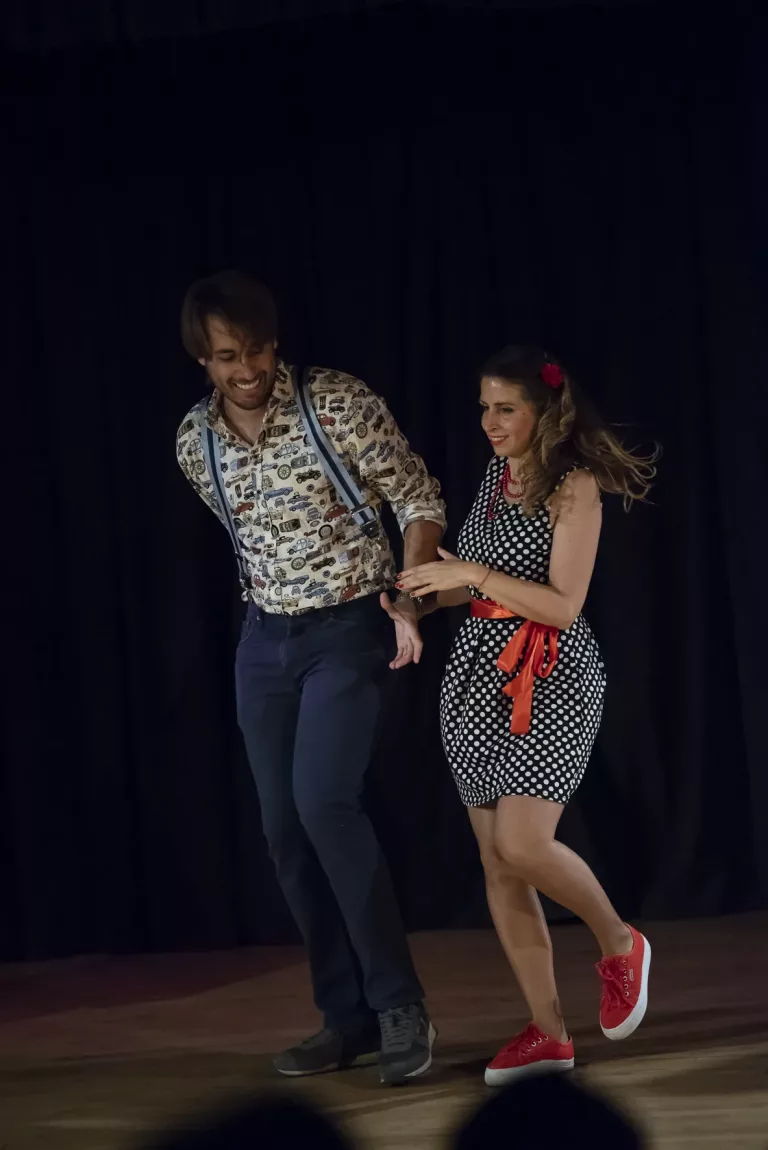
Discover our Swing classes! Come and join the most fun and energetic classes around. Swing is the dance trend everyone is talking about—an estimated 3,000+ dancers practice it across Madrid, Valencia, and Vitoria. Swing represents pure joy, and those who dance it proudly reclaim it as a true lifestyle.
HOW DO I SIGN UP?
SUPER EASY!
- Call or WhatsApp us at 634 125 052
- We’ll reserve your spot in our Swing classes
MEET OUR SWING INSTRUCTOR
Cheerful, friendly, and positive, she has been drawn to wild and fun rhythms since she was little. She discovered swing through her love for vintage fashion. From that point on, she realized she had been watching people dance this musical genre her whole life through old Hollywood movies and Disney classics, where characters dance to this exciting and creative music in various styles. Among all that inspiration, she came across a clip from the 1944 film Hellzapoppin', which moved her deeply as she watched the incredible performance by the legendary dance troupe Whitey’s Lindy Hoppers.
That video convinced her once and for all that Lindy Hop was exactly what she was looking for. Since then, she hasn't stopped learning and enjoying swing. She is so thrilled with this discovery that she wants to bring this passionate world to the neighborhoods around Madrid—since most of the scene happens in the city center—helping everyone enjoy the benefits of music and dance.

Cristina Manzanares Rodríguez
Perfect Methods for Beginners
If you've never danced before, you're in the right place. We guide you step-by-step from zero.
Small Class Sizes
Learn faster with personalized attention and tailored feedback.
Specialized Teachers
Certified instructors with years of teaching and dancing experience.
Fun & Social Atmosphere
Connect with new people right from your very first class.
No Registration Fee & No Commitment
No sign-up fee, no long-term contracts. You decide how involved you want to be.
Here are a few videos featuring our talented students!
¿Qué modalidad te interesa más?
PROFESIONAL

55€/ mes
Apúntate a nuestras clases grupales 2 veces por semana y aprende mucho más rápido! por tan solo 55€ al mes
BÁSICO

40€/ mes
¿Quieres aprender a bailar, divertirte y echarte a la pista de baile cuando ponen ese tema que tanto te gusta? Apúntate a nuestras clases grupales, 1 vez por semana, por tan solo 40€ al mes
HISTORY OF SWING
Conventional jazz history typically defines the Swing Era as spanning roughly between 1935 and 1945. However, these dates shift when considering both the incubation period of swing music and its subsequent transition era. Regardless, the wildly successful concert by the Benny Goodman Orchestra on August 21, 1935, is widely considered the start of an era where public acceptance of jazz broke all historical precedents.
The Wall Street crash of 1929 plunged the United States into a deep, decade-long economic crisis: The Great Depression. Popular music and jazz, which seemed to have stalled in their evolution, were actually undergoing a major transition.
The most innovative and powerful ideas driving the development of orchestral jazz—that is, swing—were born out of the African American experience through icons like Jelly Roll Morton, Duke Ellington, Don Redman, John Nesbitt, Jimmy Mundy, Edgar Sampson, Benny Carter, Eddie Durham, Mary Lou Williams, Horace Henderson, and Sy Oliver.
Fletcher Henderson was pivotal in creating an environment where idealistic jazz musicians could play exciting, complex, and interesting orchestrations that were also commercially viable. These musicians introduced written arrangements for specific orchestra sections (brass, reeds, etc.) while opening up space for brilliant soloists to showcase their virtuosity. This was combined with fundamental changes in the rhythm section, such as the drummer shifting the timekeeping toward a smoother, more diffused sound using the cymbals, hi-hat, and a continuous sweep of wire brushes across the snare drum. By placing equal emphasis on all four beats of the measure (4/4 time), the rhythm became much more fluid and driving. Additional innovations by arrangers included the call-and-response pattern—rooted in African American traditions—where riffs (simple repeated phrases) played by one section clashed playfully against another (brass vs. woodwinds), setting the stage for soaring solo improvisations. Extra touches like crescendos peaking in raspy brass sounds, orchestral breaks where only the rhythm section plays, unison saxophone phrases, and solo breaks all contributed to creating a music that made the urge to dance virtually irresistible.
*Excerpt from the foreword of the book "Swingin' at the Savoy: The Memoir of a Jazz Dancer" by Norma Miller.
Horarios y niveles disponibles
Si estás interesado/a en aprender Swing/LindyHop, te invitamos a consultar los horarios completos de la escuela, donde podrás ver todas las opciones disponibles y elegir la que mejor se ajuste a tus necesidades
Ocio a través del baile
Desde hace un tiempo, las clases swing se han puesto muy de moda, por lo que surge un ocio maravilloso alrededor de este. Podemos encontrar todo tipo de eventos para disfrutar con otros apasionados por el swing, ya sea en salas de baile, en centros culturales o en la calle. Cualquier sitio es ideal para disfrutar de la música, el baile, la gente, el lugar, el momento y los múltiples beneficios que todo esto nos aporta.
Al bailar, entramos en contacto con una sensación de bienestar con nosotros mismos, por lo que nos sentimos más vivos y esto nos ayuda a tener una nueva perspectiva sobre todo lo que nos rodea. Esto ocurre desde el primer momento, pero cuando “bailamos” regularmente, los cambios son aún más profundos. Desconectamos de nuestras preocupaciones, ponemos atención en el momento que estamos viviendo, a escuchar la música, a disfrutar del entorno, a comunicarnos con nuestra pareja de baile, a desarrollar la creatividad a través de la interpretación musical, etc.
Got Questions? We Have Answers.
Swing is a style of music that originated in the United States in the 1920s and 1930s, giving birth to several social dances.
Lindy Hop is the most iconic social dance of swing music, born in the 1920s and 30s in Harlem (New York). It combines steps from Charleston, jazz, and tap, with a lot of improvisation, rhythm, and connection between partners and the music.
When we talk about "dancing Swing," we usually refer to dancing Lindy Hop, although other swing dances like Balboa or Collegiate Shag also exist.
No. In class, partners rotate constantly, allowing you to practice with different people, improve your connection, and get to know the group.
If you come with a partner, you can either dance together or join the rotations—whichever you prefer!
In Lindy Hop, there are two roles:
Leader: Suggests and leads the movements.
Follower: Interprets and responds to the lead. Both are equally important, and you can learn whichever one you prefer (or both over time!).
No. Beginner-level classes are designed to start completely from scratch. You will learn rhythm, basic steps, partner connection, and simple moves. The most important thing is to come with a positive attitude and a desire to have fun.
Comfortable clothing that allows you to move freely.
Shoes with smooth or slightly slick soles (avoid heavy rubber) to make turns easier.
Water, great energy, and your smile—swing is all about enjoying yourself!
Mainly swing jazz music from the big bands of the 1930s and 40s (Count Basie, Duke Ellington, Benny Goodman…). Modern tracks inspired by that characteristic syncopated rhythm that gets you moving can also be used.
Not particularly. It’s an active dance, but everyone can adapt the intensity to their own level. Over time, it improves your coordination, endurance, and balance. The key is to listen to your body and enjoy the movement.
Classes usually last between 55 and 60 minutes, including a warm-up, technique practice, and social dancing at the end.
